



Understanding PPWR: What It Means for Pharmaceutical & Medical Device Packaging
Sustainability expectations across Europe are evolving rapidly, and one of the most significant developments impacting the packaging industry is the EU Packaging and Packaging Waste Regulation (PPWR).
Designed to support a more circular economy, PPWR introduces new requirements around packaging sustainability, recyclability, waste reduction, and material usage across the European market.
For pharmaceutical and medical device companies, however, the conversation is far more complex than simply making packaging recyclable.
In healthcare applications, packaging is not only responsible for containment — it plays a critical role in protecting product stability, maintaining sterility, supporting patient safety, and ensuring regulatory compliance throughout the product lifecycle.
As a result, understanding how PPWR applies to pharmaceutical and medical device packaging requires a more nuanced, application-specific approach.
For pharmaceutical and medical device companies, however, the conversation is far more complex than simply making packaging recyclable.
In healthcare applications, packaging is not only responsible for containment — it plays a critical role in protecting product stability, maintaining sterility, supporting patient safety, and ensuring regulatory compliance throughout the product lifecycle.
As a result, understanding how PPWR applies to pharmaceutical and medical device packaging requires a more nuanced, application-specific approach.
Share this story
What is PPWR?
The Packaging and Packaging Waste Regulation (EU) 2025/40 entered into force in February 2025 and will become applicable across EU Member States beginning in August 2026.
The regulation is intended to:
For many industries, PPWR introduces new expectations around packaging design, recyclability, labeling, and documentation.
However, pharmaceutical and medical device packaging present unique technical and regulatory considerations that require additional flexibility.
The regulation is intended to:
- Reduce packaging waste
- Improve packaging recyclability
- Harmonize packaging requirements across Europe
- Encourage more sustainable material use
For many industries, PPWR introduces new expectations around packaging design, recyclability, labeling, and documentation.
However, pharmaceutical and medical device packaging present unique technical and regulatory considerations that require additional flexibility.
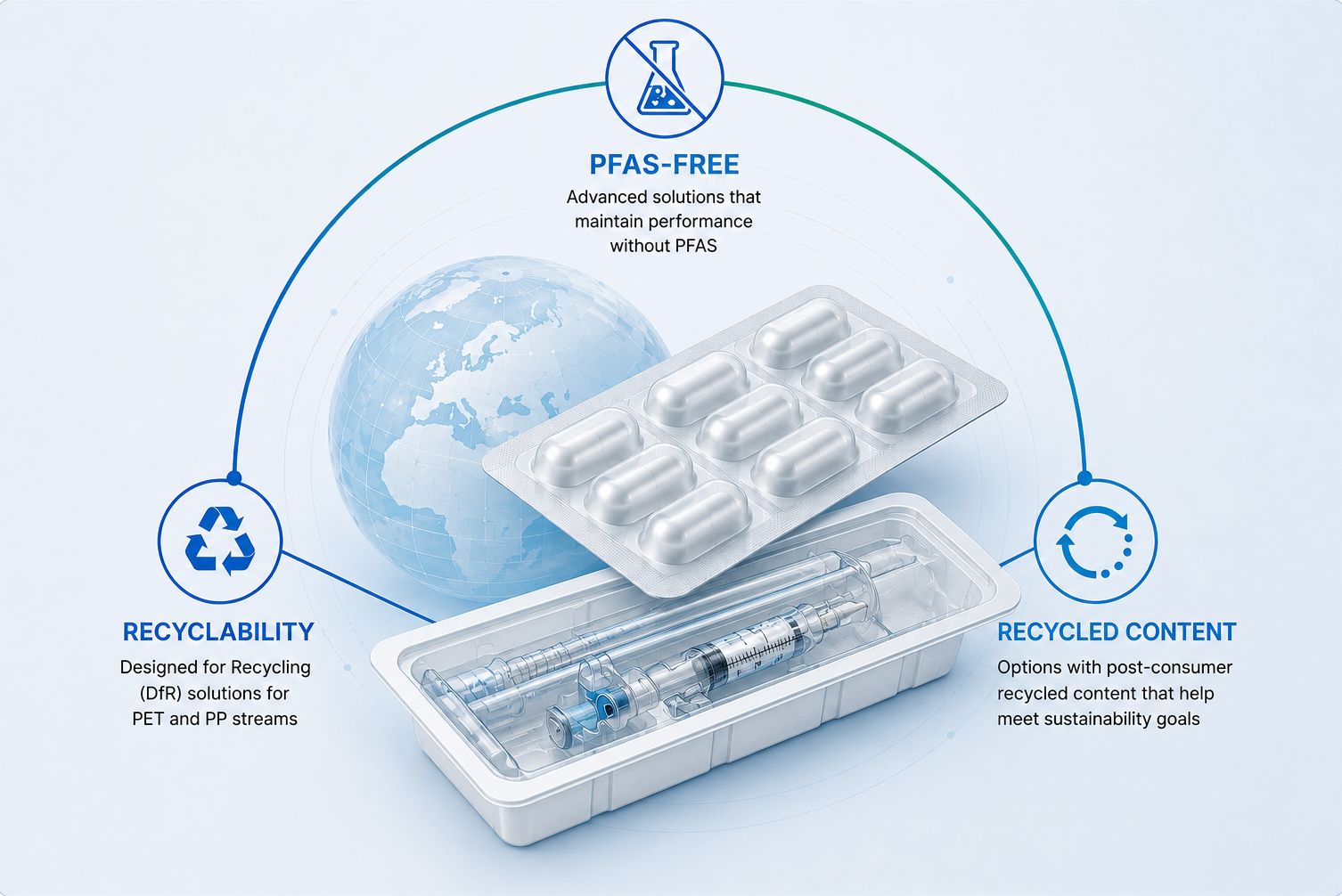
Why Pharmaceutical & Medical Device Packaging is Different
Unlike many consumer packaging applications, pharmaceutical and medical device packaging must first and foremost protect the product and the patient.
Packaging used in these applications is carefully engineered to:
Because of these requirements, material selection in healthcare packaging is often driven by performance, safety, and compliance before recyclability considerations can be evaluated.
PPWR recognizes this reality.
- Protect against moisture and oxygen
- Maintain product stability and shelf life
- Support sterile barrier performance
- Meet strict migration and material safety requirements
- Ensure compatibility with regulatory and validation standards
Because of these requirements, material selection in healthcare packaging is often driven by performance, safety, and compliance before recyclability considerations can be evaluated.
PPWR recognizes this reality.
When Safety Comes First
PPWR does not exclude pharmaceutical or medical device packaging from sustainability expectations. However, the regulation acknowledges that highly sensitive applications may require specific flexibility where health, safety, or product integrity could otherwise be compromised.
In practice, this means certain recyclability requirements may be adjusted or waived where necessary to ensure:
This is especially important for high-barrier and sterile packaging applications where performance requirements remain critical.
In practice, this means certain recyclability requirements may be adjusted or waived where necessary to ensure:
- Drug stability
- Sterility maintenance
- Medical device protection
- Patient safety
- Compliance with existing medicinal product regulations
This is especially important for high-barrier and sterile packaging applications where performance requirements remain critical.

What PPWR May Impact
While exemptions and application-specific considerations remain important, PPWR is still expected to influence several areas within pharmaceutical and medical device packaging development.
These include:
- Increased focus on packaging recyclability
- Greater scrutiny of complex multi-material structures
- Expanded sustainability documentation requirements
- Increased attention on packaging design efficiency
- More detailed material assessments and compliance reviews
- Mono-material or recycling-compatible packaging structures
- Recyclability-focused packaging designs
- Material transparency and technical documentation
- Long-term sustainability strategies for healthcare packaging
At the same time, maintaining product protection and regulatory compliance will remain essential.
Understanding the Complexity
One of the challenges surrounding PPWR is that pharmaceutical and medical device packaging does not operate under a single simplified regulatory framework.
Instead, compliance often relies on a combination of:
This makes packaging evaluations highly application-specific.
There is no universal “one-size-fits-all” solution for healthcare packaging, particularly when barrier performance, sterile protection, or long-term stability are involved.
High-performance materials used in pharmaceutical packaging, including fluoropolymer-based barrier structures such as PCTFE laminates, continue to play an important role in applications requiring exceptional moisture barrier performance and product protection.
As sustainability expectations evolve, the industry continues to evaluate how to balance circularity objectives with the demanding technical requirements of healthcare packaging.
- Material-specific regulations
- Risk assessments
- Migration and compatibility testing
- Technical documentation
- Product-specific regulatory requirements
This makes packaging evaluations highly application-specific.
There is no universal “one-size-fits-all” solution for healthcare packaging, particularly when barrier performance, sterile protection, or long-term stability are involved.
High-performance materials used in pharmaceutical packaging, including fluoropolymer-based barrier structures such as PCTFE laminates, continue to play an important role in applications requiring exceptional moisture barrier performance and product protection.
As sustainability expectations evolve, the industry continues to evaluate how to balance circularity objectives with the demanding technical requirements of healthcare packaging.
What This Means for Pharmaceutical & Medical Device Companies
The key takeaway is that PPWR does not replace the existing regulatory framework governing pharmaceutical and medical device packaging.
However, it does introduce additional sustainability expectations that companies should begin preparing for now.
Moving forward, many organizations will likely need to:
The companies best positioned for the future will be those that can successfully balance sustainability objectives with product performance, regulatory compliance, and patient safety.
However, it does introduce additional sustainability expectations that companies should begin preparing for now.
Moving forward, many organizations will likely need to:
- Reassess packaging sustainability strategies
- Evaluate recyclability considerations earlier in development
- Review material and structure selections
- Strengthen technical documentation and compliance support
- Collaborate more closely with packaging suppliers and development partners
The companies best positioned for the future will be those that can successfully balance sustainability objectives with product performance, regulatory compliance, and patient safety.
How We Support Our Customers
Navigating evolving regulations like PPWR requires more than material supply alone.
We support our pharmaceutical and medical device customers by helping translate complex regulatory and sustainability requirements into practical packaging guidance.
Through our i.center capabilities and Application Engineering support, we assist customers with:
As the regulatory landscape continues to evolve, collaboration across the packaging value chain will become increasingly important.
If you have questions about PPWR or how it may impact your packaging applications, our team is here to help.
We support our pharmaceutical and medical device customers by helping translate complex regulatory and sustainability requirements into practical packaging guidance.
Through our i.center capabilities and Application Engineering support, we assist customers with:
- Material evaluations
- Packaging design considerations
- Sustainability assessments
- Regulatory and technical guidance
- Performance testing and validation support
As the regulatory landscape continues to evolve, collaboration across the packaging value chain will become increasingly important.
If you have questions about PPWR or how it may impact your packaging applications, our team is here to help.
Follow us


Contact us
Klöckner Pentaplast GroupCapital House, 4th Floor,
25 Chapel Street
London NW1 5DH
United Kingdom
Legal
Copyright® Klöckner Pentaplast 2026 | kp and other kp marks are registered or proprietary marks of Klöckner Pentaplast